


Meta Strategy Derivatives Portfolio – Probability Map Update
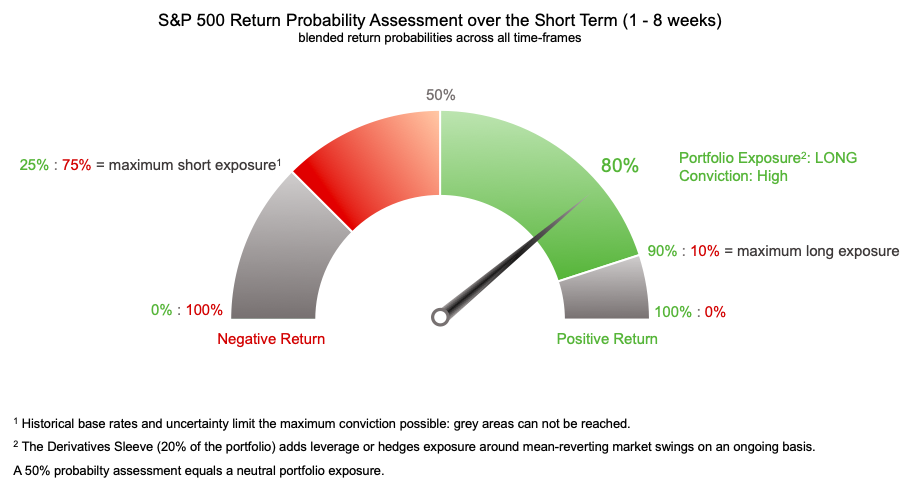
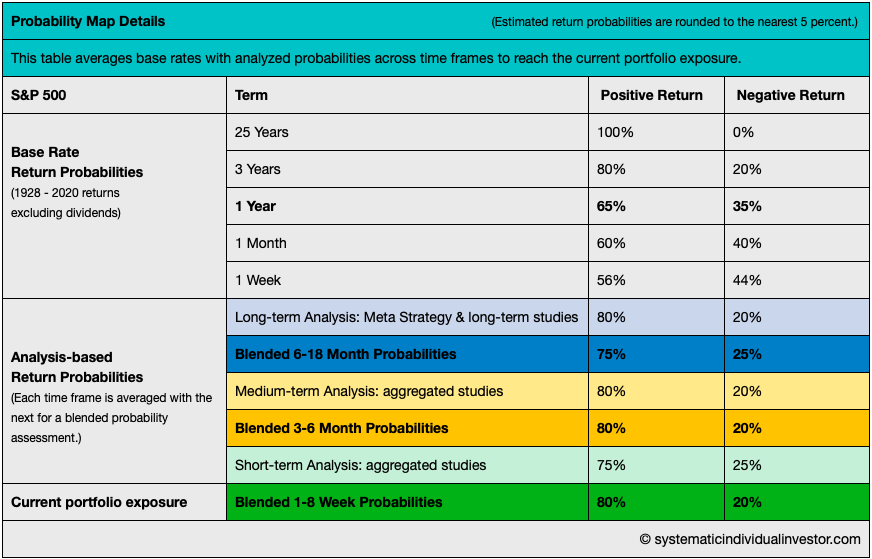
The dashboard shows my current data-driven estimate of the probabilities for future returns of the S&P 500 over the short term (1 – 8 weeks), medium term (3 – 6 months), and long term (6 – 18 months). It is updated each Monday and is followed by a detailed probability table, a review of key market drivers, relevant studies, price targets, model portfolios, and trading ideas.
Exposure to the market is adjusted according to short-term probabilities — to profit from market swings lasting 1 to 8 weeks — thereby improving the overall returns of a tactical, long-term ETF investment portfolio.
Please check back for updates around key price levels during the week in the “Current Trades” section below.
For intra-week commentary, follow me on Twitter: @indievesting.
For background information, please read this article.
Probability Dashboard


Opportunity Assessment

Coming out of a pullback the opportunity is great and may last through January.
This is a visual representation of the quality of the opportunity I see in the current market. I use it to scale my bet sizes dynamically (more details in the FAQs):
- Red: not a good edge — scale down position sizes (e.g. x 0.5)
- Yellow: regular, decent opportunity — use regular position sizes as listed in the model portfolio
- Green: great opportunities occur only a few times each year — increase position sizes (e.g. position size x 1.5)
- The linear position scaling in the model portfolio will stay unchanged, and the factors above can then be added according to individual preferences.
Current Outlook
Portfolio Rebalancing
From its October low, the S&P rallied 7,7% (which is close to the average yearly stock market gain) in an almost vertical line. Minor pullbacks never came close to what I characterize as “random pullbacks” to the zero gamma / 20 dma levels. The chance of a small, buyable pullback has risen, but my overall assessment is largely unchanged and I will use the current situation to take a little detour into portfolio construction today.
The strong rally had two major effects on the model trading portfolio:
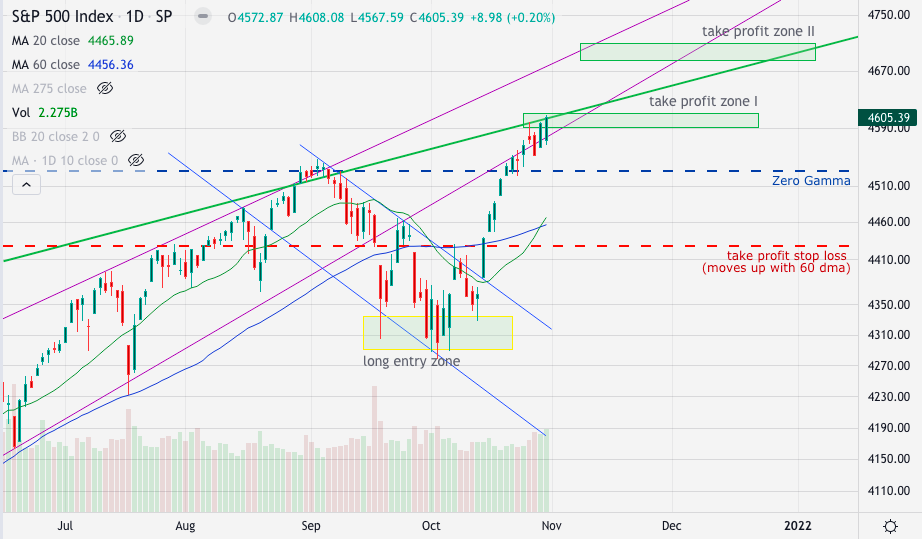
(a) Two profit targets were reached (previous ATH and channel resistance around 4600), which brought down long exposure (now 25% of trading capital) below the core position size (50%) that I aim to hold for a year-end rally scenario. The “Current Trades” section below addresses how I plan to re-establish that core position.
(b) The core long position, which was bought around 4300 (average entry of two 25% positions) shows an exceptional gain of well over 100% — half of which was realized last week. Added to this are several smaller profits (15% – 40% on long and short positions) over the last two months, which have brought the balance between my investment portfolio (80% of capital) and the trading portfolio (20% of capital) out of whack.
Why split investment capital?
Active trading is risky and the potential for outsized gains comes with the risk of steep losing periods. Over the years, I have repeatedly gone through a cycle that probably sounds familiar to many traders: compound a trading account slowly and carefully over a period of time only to give back those gains quickly during a losing period — often caused by overconfidence triggered by a sequence of successful trades.
My solution for this problem is to split my investment capital into a long-term tactical asset allocation portfolio (the systematic Meta Strategy ETF portfolio described in my monthly newsletter) for the majority of my money and only use a smaller fraction for trading. Large profits are removed from the trading account, and even a complete loss of trading capital does not jeopardize my financial position — it is a built in risk control mechanism.
Rebalancing
Usually compounding happens slowly and I automatically rebalance by taking living expenses out of my account at a set threshold (e.g. when the trading portfolio reaches 25% of my overall capital, I transfer 5% into a cash account). The same threshold can be used to rebalance a compounding portfolio: 4% would be transferred to and invested in the current portfolio ETFs and both portfolio parts would grow with the size of the overall portfolio.
An unusually quick jump in capital (or drop in case of an outsized loss) can overshoot rebalancing targets while still in a trade and the sale of a position is a good opportunity to balance back to an equilibrium.
Using only the core trading long position and rounded P/L percentages shows the following simplified situation:
A 50% long trading position equals 10% of overall capital (half of the 20% trading portfolio allocation) and a doubling of that position increases the trading portfolio allocation (and its risk) significantly to 30% of available capital. At the sale of a part of the core position, a third of the trading portfolio capital would need to be taken out of the portfolio (building a cash buffer for potential future losses is an interesting idea here) or redistributed. The key for me is to actually remove the capital from my trading account (I keep my ETF portfolio in a separate account) to avoid breaking my own rules through overconfidence.
Looking at the rebalanced trading portfolio positioning, we can now see that the remaining 25% long position has in fact become a 50% position at its current value (it has doubled, while the trading capital was reduced to its original size). This needs to be taken into account when setting position sizes to add long positions in a pullback. My rule of thumb in this case is to use the approximate position value at the trailing stop loss exit (red line in the chart) rather than the current value, because book profits are very different from realized profits — with smaller book gains, I simply use the position value at entry until profits or losses are realized.

Current Trades and intra-week Updates
A summary of changes and planned activity. (Find detailed price target tables, risk management, trade setups, model portfolios, alternative strategies, and trading FAQs below.)
Updates, as announced in the Member Area, will be listed here in green.
Trading portfolio at the beginning of the week:
The model portfolio is positioned 25% long, as the S&P pushed on relentlessly to reach my main target, which is defined by strong resistance at the upper channel boundary of the post-2009 uptrend (green line on the chart above).
Core long position
I now use the Buy the Gamma Dip setup to re-enter long positions at any random pullback to the zero gamma level (currently 4530), and increase its position size to two full positions (after rebalancing my portfolios) to get my core long position back up to a 50% optimal size, and hold one of these positions for a longer time period with a higher profit target than the setup usually specifies.
A trailing stop loss below the 60 dma protects a profit and will move up over time with the S&P.
Publishing note: If you want to read my report on Sunday to prepare for the next trading week, you will usually find it up on the website by late afternoon. With the Monday morning email, I will sometimes add updates if my outlook is influenced by the Sunday / Monday pre-market open.
Probability ≠ Certainty: All that I state here are my personal ideas and best guesses, which I use to make my own investment decisions. (I may hold positions discussed here.) It is not investment advice. Everyone is responsible for their own investment decisions and potential losses.
Key Insights
(These change gradually and at major inflection points)
Current Market Environment (defined by Meta Strategy Indicators): Quiet Bull Market Regime
- Basic Premise: Market Environments tend to stick around, so adjusting strategies to the current regime and trading with the trend have the best odds for success over the long term.
- Market Regime — Bull Market: We can now wait for warning signals for a potential regime change from the Meta Strategy model rather than try to predict uncertain long-term developments.
- Volatility: Vix now trades back in its stable sub-20 range after a pair of strong spikes during a prolonged S&P pullback. It has broken its recent series of higher lows, which is a good sign, as Vix often increases during a long-term market top.
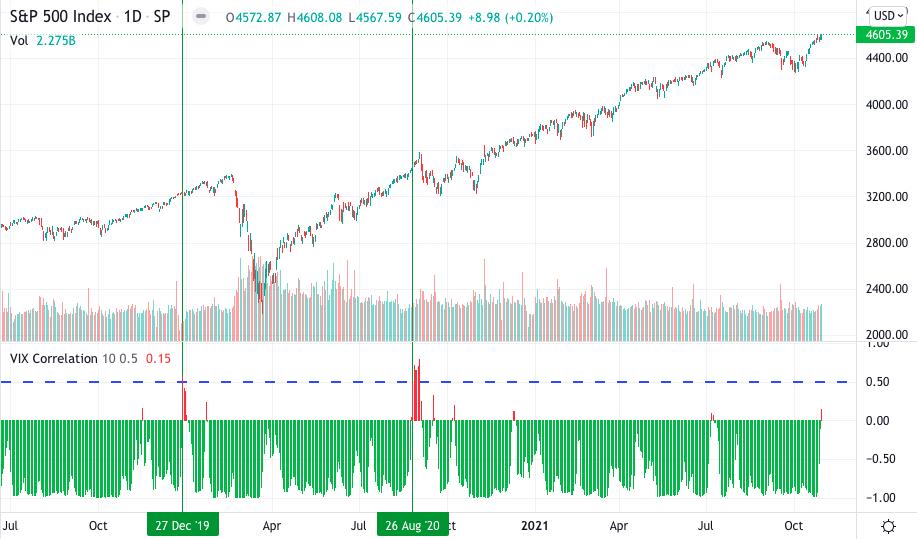
Last week the Vix / SPX correlation turned positive, which shows a higher chance of an imminent pullback — however the first dip in a strong rally is usually bought quickly.

Current Influential Market Drivers
(These details change frequently, as new information is included continually)
- Positive long-term background: The stock market’s long-term picture is well supported by strong trends, exceptional momentum, a lower volatility range, and solid economic fundamentals. The pace of the last weeks is obviously unsustainable and will slow down sooner rather than later, but my base case remains to expect positive returns over the short, medium and long term (2 -12 months).
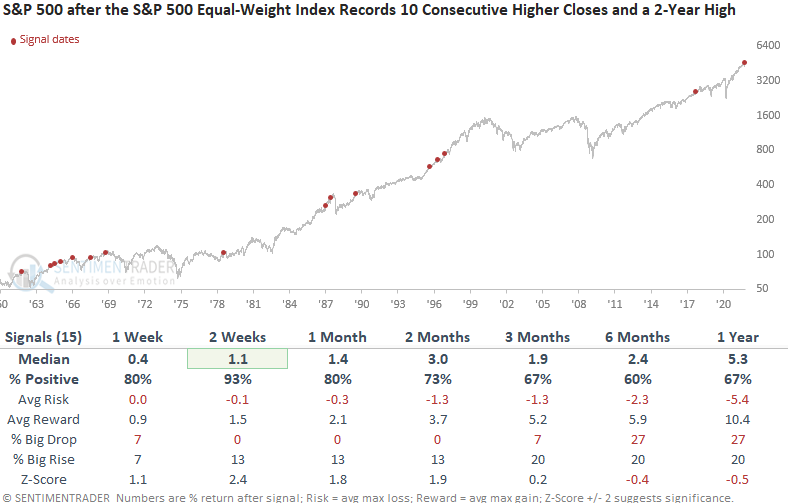
The setup of a first significant consolidation in a long time paired with instant pessimism was followed by a variety of thrusts and a sustained breakout to new all-time highs. My main scenario is a year-end rally in stair-steps with plenty of buying opportunities at support zones around the 20 dma or 60 dma. - Sustained rally: Stocks shot up over the last two weeks, but an unusually high number of consecutive green days does not mean a correction must be imminent — quite the opposite, if history is any guide.

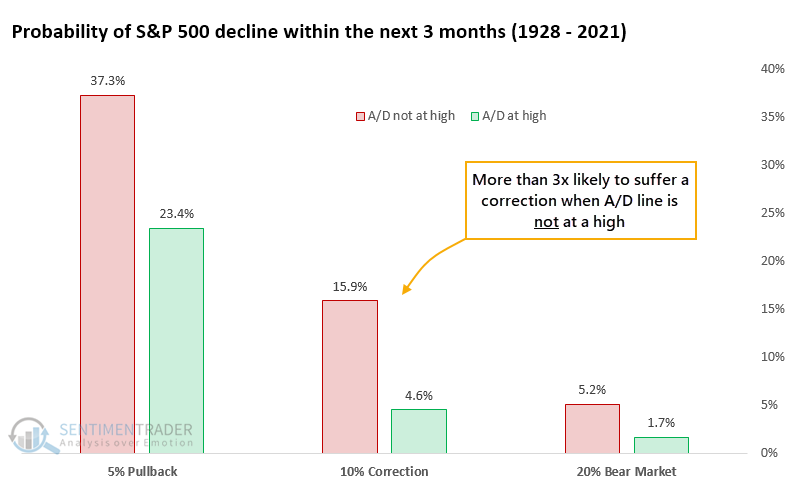
- Breadth is back: One of the best known breadth measurements, the NYSE Advance – Decline line, is back at all-time highs after a prolonged period — a very good sign for the stability of the current market.

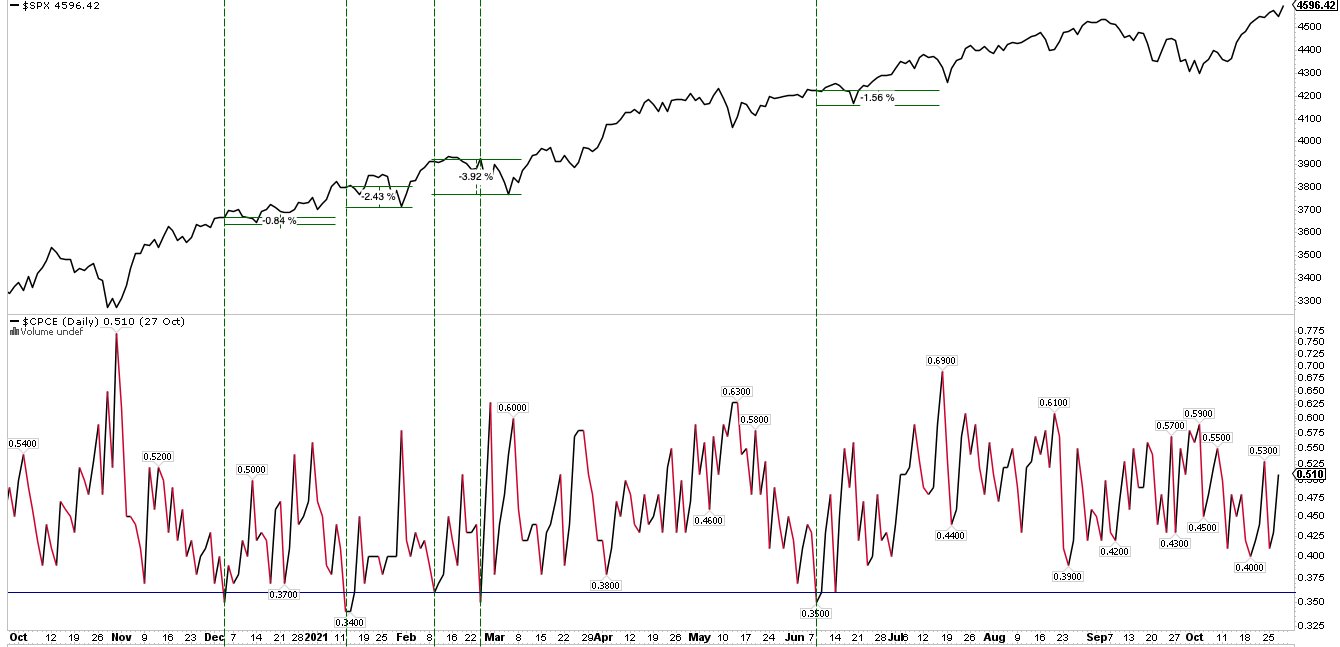
- Put / Call ratio: An extremely low ratio often leads to a stock market consolidation, though most of the time in the form of a shallow, short breather in an uptrend — this supports the idea that the current unsustainable pace morphs into a slower advance interspersed by buyable dips of 2% – 4%.

- Seasonality: 2021 is a year during which seasonality has worked extremely well, and now the historically best three month period (November through January) begins.

- 10/29 Gamma Exposure: SPX price 4605 = long; Zero Gamma = 4530.
Quickly increasing gamma exposure is likely to dampen index volatility, while options market flows (vanna and charm) are supportive. This leads to a stair-step grind up as the most likely trajectory.
Main Fundamental market drivers
- Central banks and fiscal stimulus: The FED Balance Sheet’s rise, as well as the steep climb in M2 money supply, are highly correlated with a climbing stock market. The massive excess liquidity is the main reason for asset price inflation, pushing many equity market metrics (valuations and sentiment) to extreme levels.
The waning momentum of liquidity creation is the greatest current threat to equity markets, and special attention should be placed on the point when liquidity growth actually turns negative. The September FOMC meeting set a schedule for the coming liquidity reduction.

- Inflation and FED tapering: Inflation is on the rise, which moves the FED tapering narrative front and center. This is especially worrisome, as current economic data is starting to disappoint expectations more often than not.

- Stock valuations: Valuations are very high, capping prospects for a new, long bull market. While valuations are a bad timing indicator, high valuations correlate with poor returns over the next 5 to 10 years. A good mental model is to equate valuations with the height stocks can fall from once we enter a new bear market regime.
Unprecedented monetary and fiscal stimulus, however, have created the “Mother of All Meltups (MAMU),” the end of which is hard to fathom. - Meta Strategy indicators: All six of the fundamental strategy indicators are giving a green signal and would need to flip back to red to materially change the positive post-pandemic outlook. Other macro models are already signaling deteriorating conditions in some fundamental indicators.
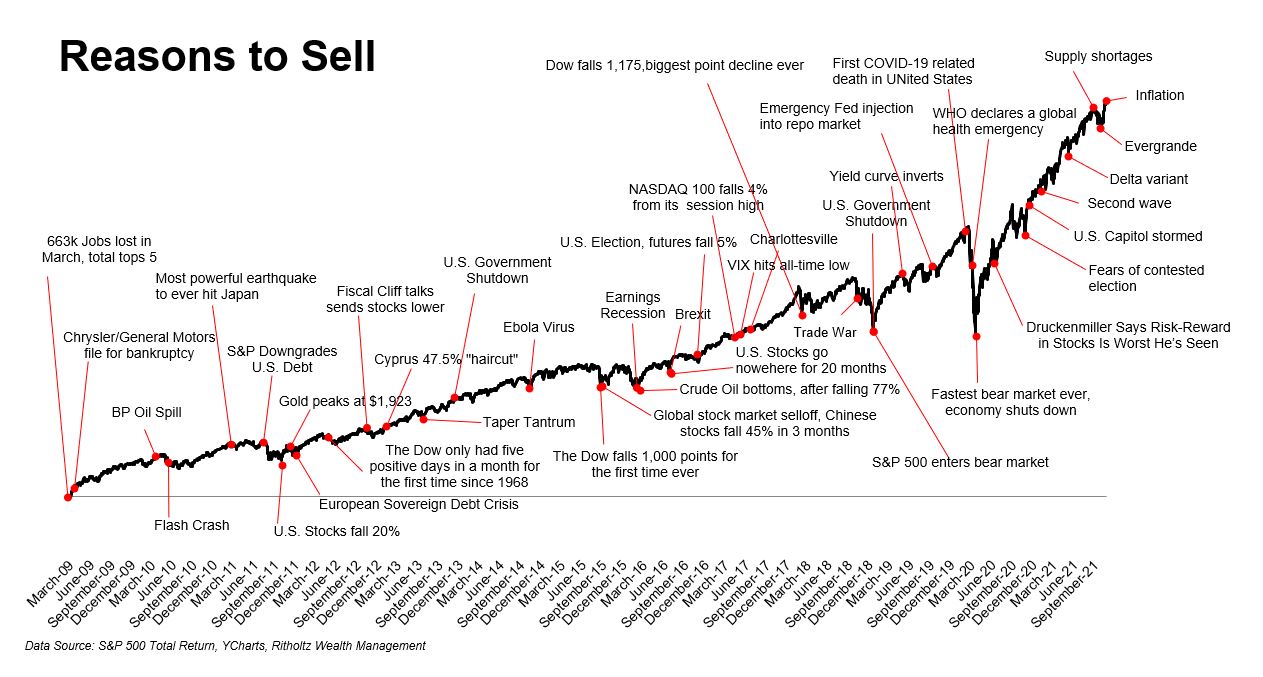
- Always something to worry about: Reasons to sell always exist and do not form the basis of a successful investment strategy. My default position is to own stocks and only listen to selected, quantifiable reasons to reduce risk systematically at opportune times.

Target Areas for the Meta Strategy Derivatives Portfolio
Please check back during the week for new updates at key levels.
| Long Targets | target reached | comment | target probability | derivatives exposure change* |
| 4590 – 4610 | yes | long-term channel | main target | close long (one position) √ |
| 4690 – 4710 | yes | upper channel boundary | ext. target | add short (hedge) √ |
*size of planned exposure changes: individual position sizes normally are 25% of the trading portfolio capital.
| Short Targets | target reached | comment | target probability | derivatives exposure change* |
| 4530 | zero gamma support | random target | add long (see trade setup) | |
| 4430 – 4460 | 60 dma | trailing stop loss (close below) | ||
| 4330 | last low |
CURRENT TRADE SETUPS
Buy The Gamma Dip — (High probability short-term trade – trade setup & rules)
Setup levels adjust with new highs — please check back for updated table during the week when indicated key levels are reached or new highs are made.
Enter long S&P 500 at any random dip back down to the Zero Gamma Level in an uptrend. Trade setup activates with long gamma exposure and a new S&P 500 intermediate high.
I add these short-term positions independently of the portfolio exposure indicated in the target areas above, or use the setup to fine tune the entry into portfolio long positions, when levels coincide with my trading portfolio’s target areas – be careful not to overshoot maximum exposure levels. Depending on how close I am to my desired overall exposure, I may give priority to the exits in the target tables above.
Trade Idea: At long gamma exposure, option market makers are forced to buy market dips to adjust hedges, often causing a quick snap-back rally. The Zero Gamma Exposure level is an important support area — it is used in this setup to calibrate two entry points slightly above and below; the stop loss level is be placed below zero gamma.
Preferred Instruments: ES/MES Futures, options or CFD;
Probability for success = 70% (backtest from 2013 to 2020; real time results from 05/20 — in some cases I will take the overall market assessment into account, if it is likely to skew success probabilities for individual trades lower);
For simplicity, I usually use the same instrument as in my current derivatives long positions indicated in the model portfolio below.
Position size: One current individual position, split into two entry points; check marks indicate filled trades.
| High S&P 11/03 | Entry 1 | Entry 2 | Avrg Entry | Stop Loss | Profit Target 1 | Profit Target 2 | Zero Gamma |
| 4665 | 4575 | 4545 | 4560 | 4500 | 4630 | 4710 | 4560 |
I increase position size to two full positions to get my core long position back up to its 50% optimal size, and hold one of those long positions for a longer time period with a higher profit target.
The Meta Strategy Derivatives Model Portfolio
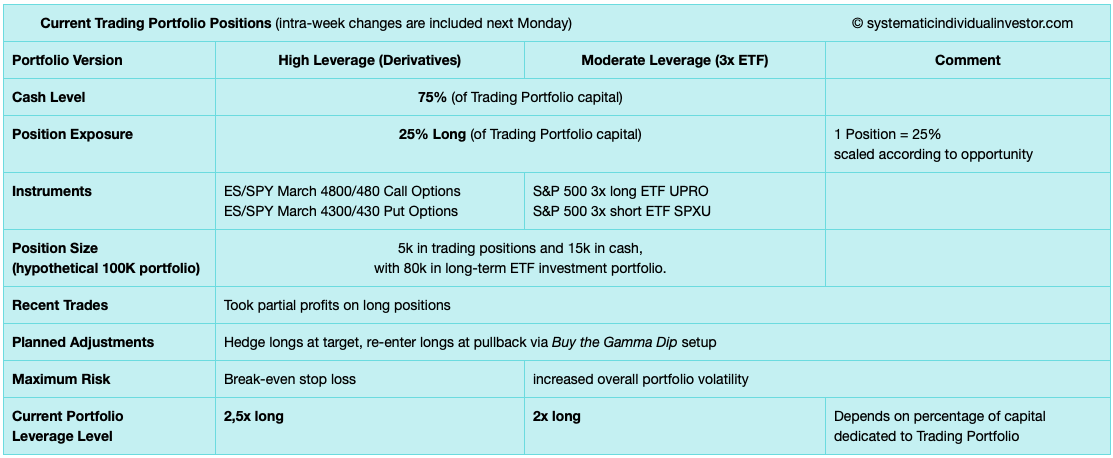
Full disclosure: These are the current positions and instruments I am invested in with the capital dedicated to the Meta Strategy Derivatives Portfolio.
A balanced exposure to the current probability estimate is achieved by combining long-term ETF positions with derivatives that are held short term.
Positions may change at any time – roughly according to the target tables above, but exact entry and exit points may vary. Instruments are not a recommendation, as there are many equally valid ways to express current probabilities: e.g. ETFs, volatility products, CFDs, futures, and many more. Also, the decision of how to set maximum leverage and risk levels fits me personally, and every trader has to be mindful of their own risk tolerance.
Investment Portfolio: The Meta Strategy Defensive & Aggressive ETF Portfolios
(with 80% of the capital dedicated to the Meta Strategy Derivatives Portfolio)
- Meta Strategy long-term exposure: 50% S&P 500 2x leveraged ETF & 50% World ex US ETF according to the monthly Meta Strategy newsletter.
- planned portfolio adjustments: none
- maximum risk (approximate distance entry to exit): S&P 500 2x leveraged ETF: exit > entry, World ETF 5% – 10%.
- positions: a hypothetical 100k portfolio would hold 40k in SSO and 40k in VEU.
Trading Portfolio: Derivatives Sleeve
(20% of capital – the size of this is the decisive factor for the maximum level of portfolio leverage)
Starting at the beginning of 2021, I list a moderate portfolio version using leveraged ETFs next to the high-leverage derivatives portfolio. The moderate version will experience lower volatility and will not lead to net short exposure in a bull market, but it will partly hedge the Investment Portfolio at opportune times. (Look at the Current Portfolio Leverage Levels in the table below for easy comparison.)





Have a safe trading week!
David
FAQ and Trading Practicalities
- What do I aim to achieve with this report?
My core portfolio is divided into two parts that work together to produce market beating returns over time.
(1) Investment Portfolio
The Meta Strategy uses systematic fundamental and technical indicators to gradually rotate a portfolio between different asset classes according to long-term market conditions. The goal is to be invested in the stock market by default and to use systematic signals to avoid the largest part of equity bear markets.
(2) Trading Portfolio
With a smaller portion of my capital, I trade derivative instruments (or leveraged ETFs) frequently to adjust exposure to the market according to short-term probabilities. My aim is to follow market swings lasting 1 to 8 weeks to improve the returns of the investment portfolio by increasing leverage during up-moves and by hedging the ETF exposure during corrections. When the probabilities for a strong correction are high, the entire portfolio’s exposure is tilted net short through derivatives, while the ETF position stays untouched.
Read about my process in detail here.
Opportunity Assessment
This new feature is a quick visual representation of the quality of the opportunity I see in the current market. Scaling position sizes according to the available opportunity set can make all the difference in a trader’s success: Most profits will usually be made during just a few excellent opportunities every year.
After analyzing past performance of my Probability Map trades, I see quite a clear tendency: Whenever many quantitative studies align to present an above-average opportunity, the net excess return that follows is what drives almost all of the outperformance of my trading portfolio. (Of course, there are still many periods where market extremes indicate a strong contrarian opportunity that does not materialize, or takes a lot of patience to profit from. As, for example, short opportunities in most of 2021.)
In contrast, low opportunities add little value overall — quite often a low opportunity trade will post a considerable drawdown before morphing into a good or great opportunity.
Therefore, I will move to scale my position sizes more dynamically to bet biggest on the best opportunities. I use a factor to adjust position sizes according to my current opportunity assessment:
Red: not a good opportunity — scale down position sizes (e.g. x 0.5)
Yellow: regular, decent opportunity — use regular position sizes as listed in the model portfolio
Green: great opportunities occur only a few times each year — increase position size (e.g. position size x 1.5)
For the weekly report, I will keep the current model portfolio with the simple linear position sizing you are used to, and add my current opportunity assessment to include in your process as you see fit. The traffic light gives a quick visual of the current status.
- Trading Practicalities
Limit Orders: I place GTC (good-till-cancelled) limit orders with my broker (IB) at both entry and exit targets, generally well before these targets are reached. Then, as circumstances might change (i.e. trade setups, options price estimates, and overall price targets), I can make adjustments to those orders.
When trading a breakout, I use the following method: After a daily close beyond the resistance / support area, I enter a limit order to be filled on a re-test of that breakout level.
I prefer to use instruments based on S&P 500 futures (ES options or ES/MES futures or CFDs in the EU), as they are traded overnight when a lot of exaggerated price spikes happen. If you have access to levered instruments that are insensitive to time and volatility, use those rather than options, but keep in mind that your maximum loss may not be capped in the same way.
In my tables, I list SPX prices (they have to be adjusted slightly for the futures) and include overnight prices in all my calculations (including orders that were filled overnight). - Stop Loss: I often work without a stop loss, especially when I start building new positions using options. I then assume my worst case scenario as a full 100% loss of the premium I paid. Such a loss will happen only very rarely, but the assumption that it is a possibility is important for setting position sizes that avoid over-leveraging.
When “placing” a stop loss beyond support / resistance, it is always as a mental note rather than a literal stop-limit order with my broker. I generally wait until the level is breached and confirmed near the market close, then place a limit order to sell (preferably just before the close to avoid the overnight gap risk).
Break-even stop loss: To avoid a winning position turning into a loser, I will often set a mental break-even target for the entire position (noted in updates and the model portfolio table). As there are bound to be small differences in each trader’s process, I won’t specify exact levels, but instead will leave it to your discretion to set the exit based on your specific entry level. I will mark the stop loss as hit according to my own actual positions. - Options expiration and strike selection: To avoid excessive time decay, I like to keep options expiration relatively long-term, in case market swings last longer than expected. Short-term probabilities should play out within 1-8 weeks and I want to avoid the last 2-3 months in an option’s lifetime (as time decay really accelerates then) — to that I add a bit of a margin of error to reach an expiration 5-7 months out. (I select the nearest quarterly expiration date, as my preferred ES futures options have limited monthly expirations available.)
The option’s strike usually equals my expected main target, as this takes optimal advantage of options convexity. Specifically, for puts, I tend to go further out-of-the-money (to maximum targets), because I like them to be sensitive to an expected volatility spike. And for calls, I tend to stay closer near-the-money (main targets) to reduce the inherent disadvantage from declining volatility in a rising market.
Disclaimer
This report is a description of my own investment approach and ideas, and I personally invest in the Meta Strategy Derivatives Portfolio. The content of this letter is for entertainment purposes only and not meant to be investment advice to others.
I am not an investment advisor and I do not provide individual investment advice. None of the ideas in this letter are meant to be construed as professional financial advice.
Your investment decisions are solely your own responsibility, and I am not legally or financially responsible for any losses you may incur from reading or using the content of this letter.
© 2020 David Steets, all rights reserved – please be fair and do not distribute without my permission